Democracy 3 is a political simulator where you play as a prime minister/president of various countries. Although, most countries in the game are Western nations. However, plenty of Steam Workshop mods add various countries, including fictitious ones and countries not in the base game.
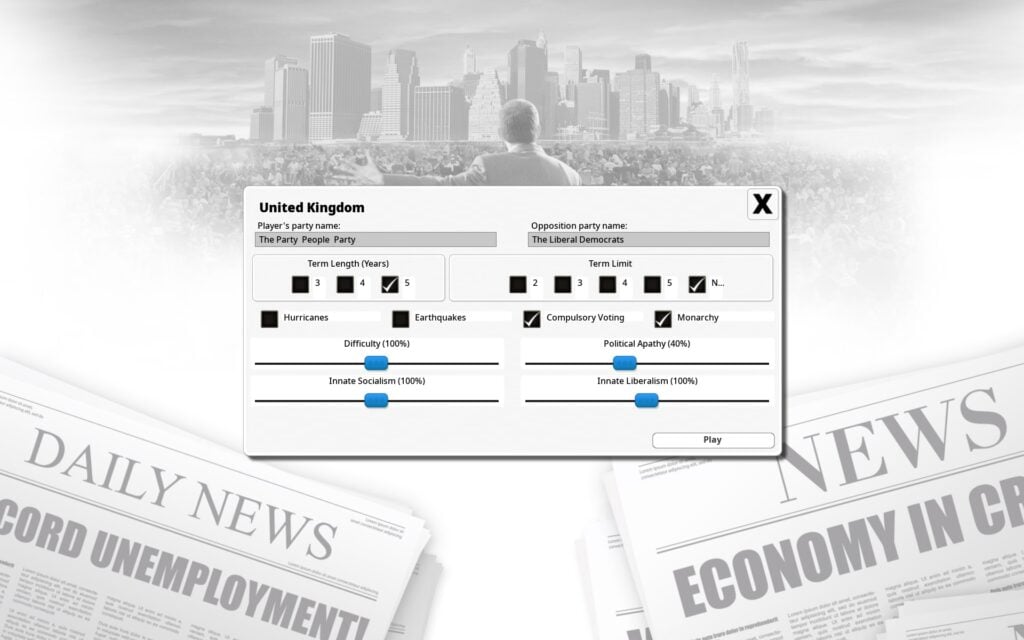
As for the game’s concept, I think it is decent on paper. At the start of the game, you can choose which country to lead, though only a limited number of countries are available. You have more choices for difficulty: you can add disasters that create a crisis at any time, make the public apathetic about voting, or even make voting obligatory. You can also shorten or lengthen terms and add or remove a monarchy in your country.
Party-wise, there are many real-world parties such as the Green Party and the Republicans. You can also create fictitious parties, which adds options for your country. Gameplay-wise, Democracy 3 is a political simulator where you decide which policies to enact. On paper, it seems like a decent enough idea to base a game around. However, you only have a limited number of policies to choose from. You can get extra policies from the Steam Workshop if you want more. Alternatively there is DLC that adds extra policies and scenarios, though it isn’t necessary. I also don’t think it changes the game much.
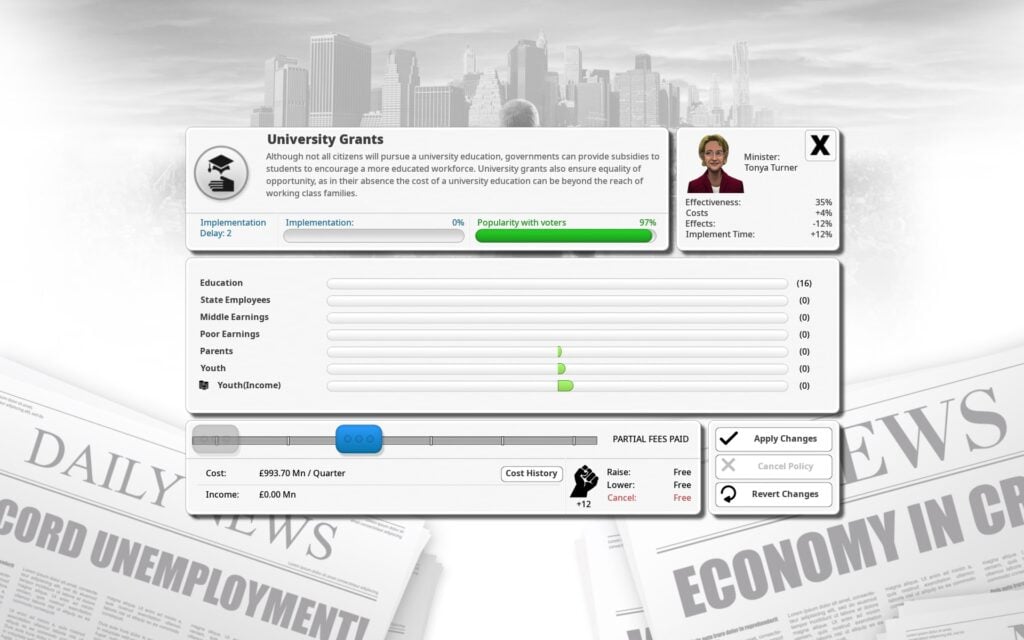
Fundamentally, many of the game’s policies are flawed and lack depth. I noticed this while enacting the university grants policy, when I saw that fees paid was the only option. On paper, this means it would pay all fees. However, I think this policy should have had multiple ways to be enacted. I would have included the option to limit which courses to pay for. Since paying for all courses wouldn’t always be beneficial as some university courses have little to no real-world use.
I also don’t like that this policy doesn’t include conditional degrees. Take degrees such as dentistry or midwifery, where the NHS needs people with them. I dislike that you can’t make these courses free. Especially, if you wanted to implement a policy where the degree is free if you work in the NHS for a set period after completion.
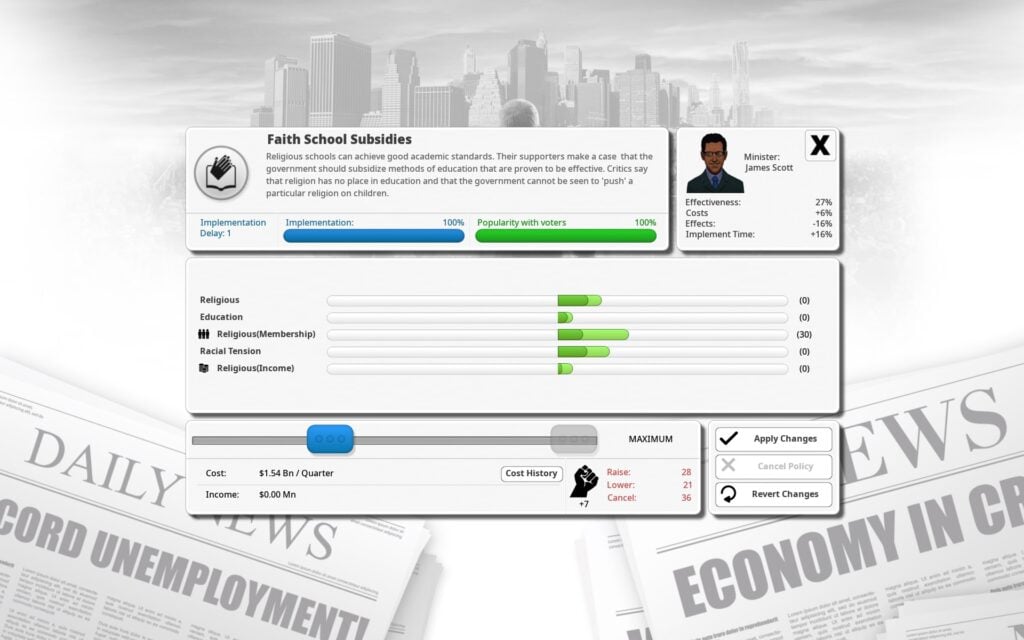
Other policies are often portrayed in black-and-white terms. The faith school subsidy policy is a great example. Funding faith schools to the maximum value allowed will greatly increase the reputation that your party has with religious people. However, this is not black and white, since there are many ways to approach it. One issue is how funding affects faith schools: if funding is provided only to schools of certain faiths, the game would portray the policy as purely good to appease religious voters. Yet, in reality, it would also detract points from various religious communities. Namely, if you purely funded state-sponsored religions such as the Church of England, there would also be uproar from every other religious group, even though you gain support from the state-sponsored religion.
This game also doesn’t say what money is spent on. I dislike that the policies as a whole don’t let you limit what is spent, where, or how. This could have made the game more complex, since providing extra funding is good. But spending money on things isn’t as good or as bad as the game suggests.
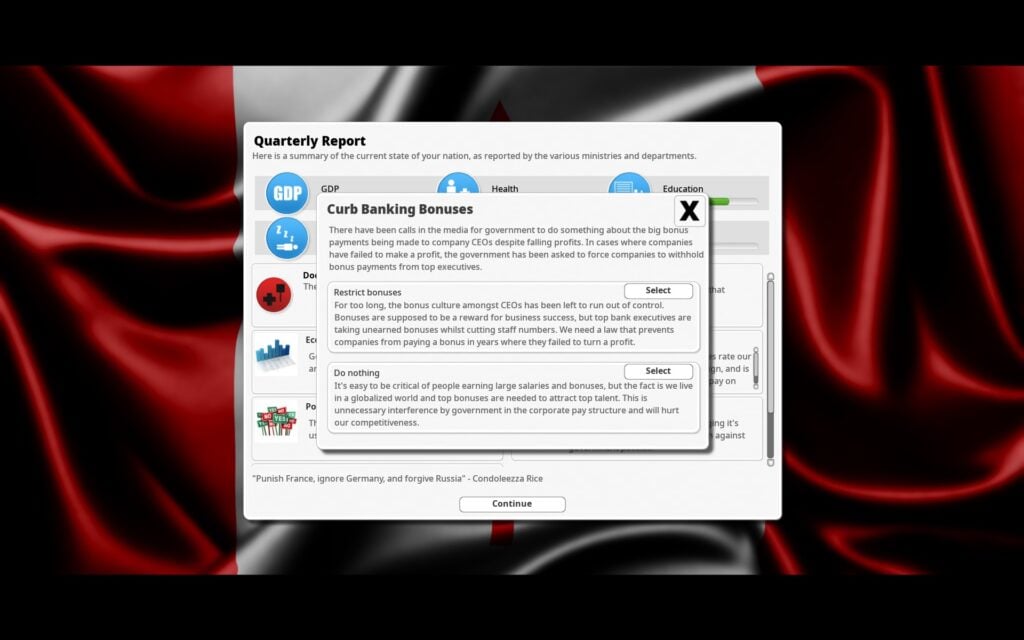
But this game is quite flawed in how it delivers policies. It won’t let you run policies based on your own objectives or interests, which I find annoying. This is because the game is based on a balancing act. For example, if you run a left- or right-wing government in the game, you won’t win one way or the other. So to succeed, you cannot ignore any of the 21 voter groups. Instead, you must take turns appeasing groups without upsetting anyone. I also found that if you try to accomplish larger tasks, such as removing the national debt, you will likely lose. Removing the national debt is hard to do without upsetting anyone, because you will either increase taxes or decrease services.
In the end, the game is too basic and lacks the options needed to feel more sophisticated. I cannot recommend this game to anyone because it is an uninteresting, dull experience that leaves little reason to play it. Overall, it feels like a shallow simulator that fails to offer enough depth to stay engaging.


